
代数图论2:代数结构
Published:
自同构 isomorphism
定义
An isomorphism from a graph $X$ to itself is called an automorphism of $X$. An automorphism is therefore a permutation of the vertices of $X$ that maps edges to edges and nonedges to nonedges.
所谓自同构,就是自己到自己的一个同构。
至于为什么要考虑自同构,是因为我们需要利用这里天然形成的一个群结构。也就是所谓“代数”。
自同构群 isomorphism group
The set of all automorphisms of $X$ forms a group, which is called the automorphism group of $X$ and denoted by $\mathrm{Aut}( X)$.
价态 Valency
The valency of a vertex xis the number of neighbours of x, and the maximum and minimum valency of a graph $X$ are the maximum and minimum values of the valencies of any vertex of $X$.
价态,大致是刻画一个点与其他点连通的程度的量。
下面有一个优美的等式,也比较好证明,主要考虑每个边都连接了两个顶点
Fubini’s throrem
\(2|E(X)| = \sum_{v \in V(X)} (\text{valency of }v)\)
Lemma 1.3.1
If $x$ is a vertex of the graph $X$ and g is an automorphism of $X$, then the vertex $y = x^g$ has. the same valency as $x$.
这说明自同构大致保持顶点与周围连接不变,该连几条边还得要连几条边。
Lemma 1.3.2
If $x$ and $y$ are vertices of $X$ and $g \in Aut(X)$, then $d(x,y) = d(x^g,y^g)$.
事实上,这表明了一些自同构的“刚性”。
补图
The complement $X$ of a graph $X$ has the same vertex set as $X$, where vertices $x$ and $y$ are adjacent in $X$ if and only if they are not adjacent in $X$ (se Figure 1.5).
简单来说,补图是将边集相对于同顶点的完全图的边集取补。 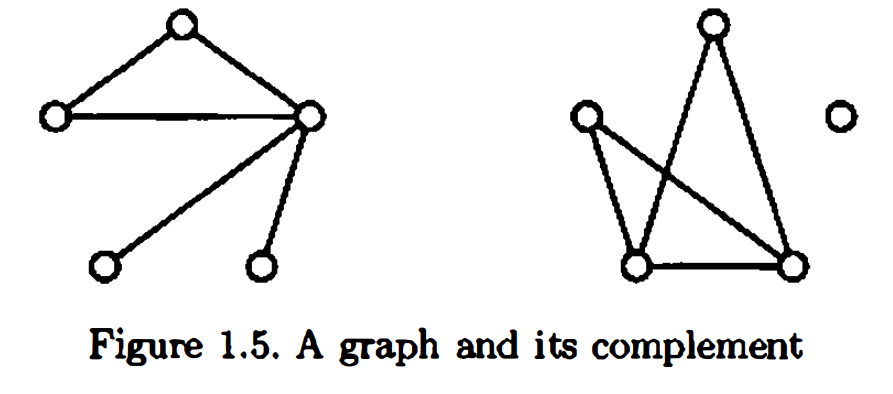
Lemma 1.3.3
The automorphism group of a graph is equal to the automorphism group of its CQmplement.
只需要证明 一个图的自同构就是它的补图的自同构。
同态 homomorphism
怎么这也有homo啊
Let $X$ and $Y$ be graphs. A mapping $f$ from $V(X)$ to $V(Y)$ is a homomorphism if $f(x)$ and $f (y)$ are adjacent in $Y$ whenever $x$ and $y$ are adjacent in $X$. (When $X$ and $Y$ have no loops, which is our usual case, this definition implies that if $x \sim y$, then $f(x) \not = f (y)$.)
事实上,同态完成的是一个折叠的感觉,而非压缩,因为它要求保持毗邻的性质,这意味着,它不能将相邻的两个点映入同一个点。
我们可以验证,两个同态的复合,依旧是一个同态。 由此,其实我们就已经定义了一个在有限图上的范畴category。只是可惜,这个同态不是additive(加性范畴)。
一些例子
Example 1
可以存在的同态 任意大的二部图,都存在一个到$K_2$的满同态 如果$|X|=n$,那么存在一个满同态$f:X \to K_n$ 不存在同态$f:K_3 \to K_2$,使得f是满的
问题
关于一个有限图,我们会好奇它所能映入的最小的kn是怎么样的。(这里的引入使用的是同态) 那么,这就与着色数有关。也就是说,给每个顶点染色,要求相邻的顶点不同色。而所需最少的颜色数,我们称之为着色数(chromatic number)。
而这与同态息息相关
Lemma 1.4.1
The chromatic number of a graph $X$ is the least integer $r$ such that there is a homomorphism from $X$ to $K_r$ .
proof. 大致想法如下, 若存在一个同态$f:X \to K_n$,那么可以将映射到同一个点的的点染成同一个颜色。因此有$n \ge r$. 另一方面,如果有一个用了r种颜色的合法染色方式,那么我们可以将同一种颜色的点映射到$K_r$的同一个点,不同颜色就映射到不同点。因为相邻的点之间颜色不同,所以会映射到$K_r$中的不同点,因此依旧存在一个边连接他们的像。因此这样定义的映射是个同态。
二部图 bipartite
A graph $X$ is called bipartite if its vertex set can be partitioned into two parts $V_1$ and $V_2$ such that every edge has one end in $V_1$ and one in $V_2$•
Theorem 树的边
对于一个树$X$, \(|E(X)| = |V(X)|-1\)
Lemma 树的叶
每个拥有至少两个顶点的树,都有一个价态为1的顶点。
Theorem 对二部图的局部刻画
$X$ is bipartite iff $X$ has an odd cycles.
proof. 简单总结一下想法, 左推右比较简单,只需要对这个环逐个染色即可导出矛盾。
右推左,不妨假设这张图是连通的(毕竟不同的两个连通分支之间几乎没有什么关系可言)。
再次强调,这里的结果都是针对简单图而言,因为如果存在点到自己的loop,那么我们 的论述就会出问题了。
收缩
A retraction is a homomorphism f from a graph X to a subgraph Y of itself such that the restriction $J Y$ off to V(Y) is the identity map. If there is a retraction from X to a subgraph Y, then we say that Y is a retract of X. If the graph X has a clique of size $k = \chi(X)$, then any $k$-colouring of X determines a retraction onto the clique.
Lemma
如果$Y$是$X$的一个收缩核(retract),那么
- $Y$ is a induced subgraph
- $\forall a,b \in V(Y), d_Y(a,b) = d_X(a,b)$
第一个是比较平凡的。 第二个则是依赖收缩映射的同态性质,这意味着在$X$中连接$a,b$一条路径,都会对应一条同样长度的在$Y$中的路径。
同态幺半群
A homomorphism from a graph $X$ to itself is called an endomorphism, and the set of all endomorphisms of $X$ is the endomorphism monoid of $X$.